The Andean Condor: An Iconic, Mythical, and Critically Endangered Bird
The Andean Condor (Vultur gryphus) is one of the most emblematic bird species in the world. It lives mainly along the Andes mountain range but can also be found along the coasts of South America. This majestic bird, with its vast wings and imposing silhouette, has fascinated naturalists for centuries and holds a special place in the cultural imagination of many civilizations, appearing in countless legends and artistic references.
In popular culture, the condor even appears in Tintin: in “The Temple of the Sun” the bird symbolizes grandeur and freedom high in the Peruvian mountains. Historically, it was sacred to pre-Columbian civilizations. Inca emperors viewed it as a messenger of the gods, a spiritual guide that connected Earth and Sky, symbolizing strength and power. For the Incas and Quechua peoples, the condor represented spiritual elevation and was believed to guide the souls of the deceased to the afterlife.
The famous Andean song “El Cóndor Pasa”, widely popularized internationally by artists such as Simon & Garfunkel, also celebrates this mythical bird. Through its haunting melody, the song evokes both the freedom and melancholy of the vast Andean landscapes.
Typical Andean landscape composed of both traditional crops and páramo areas, near the Ozogoche lagoon.
Description
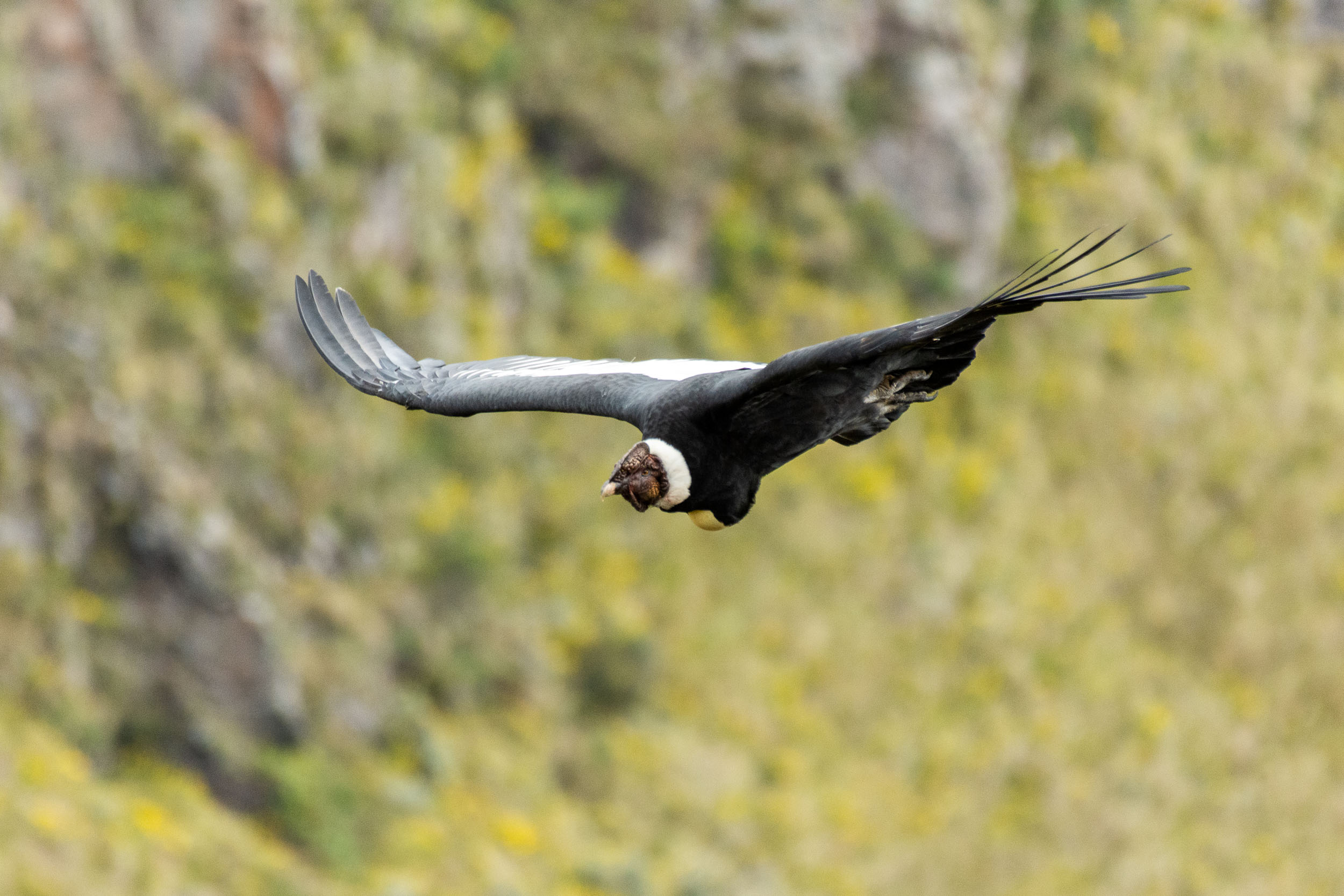
The Andean condor, one of the largest birds in the world, can reach an impressive wingspan of almost 3.5 metres in flight, making it the largest flying bird on the continent. The male has black plumage with black-grey wings and white feathers on the mirrors. A white ruff adorns the neck of the adult, and its dark grey beak lightens to ivory at the tip. A distinctive feature of this species is the ability of the skin on its head and neck to change colour depending on its emotions and reproductive phases, ranging from pink to red on the neck and yellow to pinkish on the head.
Detail of the skin on the head of an Andean condor (Vultur gryphus)
Species facts of the Andean Condor
Common name
Andean Condor
Scientific name
Vultur gryphus
Classification
Birds – Cathartide
Average lifespan in the wild
50 to 70 years
Size
3,20 to 3,50 m
Weight
8 to 15 kg
Status (IUCN Red List)
Near Threatened (NT)
With a wingspan of almost 3.5 metres, the condor is the largest flying bird on land in the world.
Habitat and diet
The Andean condor can be found in almost all South American ecosystems. It inhabits mountains, open plains, rocky areas, and also the large coastal cliffs of the Pacific at altitudes between 0 and 5,000 metres. It lives in pairs or sometimes in groups, often dominated by an adult male, and feeds on carrion, such as the carcasses of llamas and deer, as well as sea lions and pelagic birds along sandy coasts. In areas with high human activity, the carcasses of sheep, horses and cows form the basis of its diet. Its role as a natural scavenger is essential to the Andean ecosystem. Able to fly at high altitudes to locate its food, it consumes carcasses on the spot, as it cannot carry its food and can go several days without feeding.
Andean condor (Vultur gryphus) and caracara (Phalcoboenus carunculatus) feeding on cattle carcass in the buffer zone of the Antisana Reserve.
Reproduction
The reproduction rate of the Andean condor varies depending on the region studied. This depends on a number of external constraints and pressures that are still being clarified by ongoing studies. During courtship, the male undergoes a noticeable change: its skin turns bright yellow. The bird reaches sexual maturity between 6 and 7 years of age. Unlike many birds, it does not build a nest, but lays its eggs directly in isolated rock crevices. The female lays only one egg every two years, and incubation, shared by both parents, lasts approximately 54 to 58 days. The young chick takes flight after about 6 months, but remains dependent on its parents for nearly a year. In some countries, such as Ecuador, where the climate is stable all year round, when the brood is unsuccessful, the parents start a new brood almost immediately.
Behaviour
Andean condors are social birds that gather in roosts, usually inaccessible cliffs, to spend the night. They exploit warm air currents to gain altitude and glide long distances in search of animal carcasses. Their impressive wingspan allows them to cover hundreds of kilometres in a day, with hardly a flap of their wings. Within these groups, a clear social hierarchy develops, with a dominant male gaining first access to any carcasses found. The other members of the group follow, with the youngest and females often having priority later on.
Condors do not carry their food and must therefore eat on the spot. Their ability to fast for several days allows them to survive between meals. During the breeding season, condors form monogamous pairs and raise their young together.
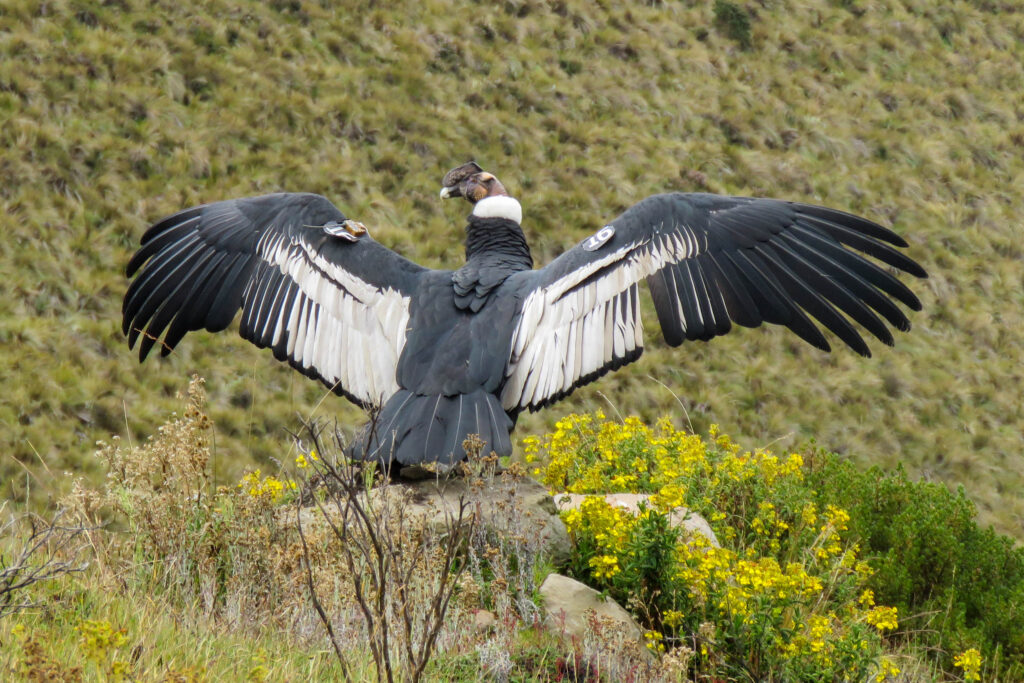
Morning stretches and ablutions before taking flight
Conservation and monitoring
The populations of Andean condors in northern South America, particularly in Ecuador and Colombia (in Venezuela, the population was completely eradicated for a long time), are much smaller and more fragmented, suffering from increased pressure due to deforestation, human activities and poaching. In contrast, in the south, particularly in Argentina and Chile, the population is larger and relatively stable, although threats such as poisoning and habitat loss persist.
Satellite tracking plays a crucial role in monitoring the condor population. In Ecuador, for example, more than 500 condor frequentation areas have been identified using tracking devices placed on the birds. These technologies make it possible to observe their movements and flight patterns and to determine their nesting areas. They also help to identify the main threats, such as poaching and habitat degradation, so that effective protection measures can be taken.
One of the individuals tagged and equipped with a tracking device, here number 16.
The Condor Andino Foundation
Conserving the Andean condor is a major challenge due to increasing anthropogenic threats. Fundación Cóndor Andino Ecuador (FCA) is a non-profit organisation dedicated to scientific research and conservation of the Andean condor and other endangered species in Ecuador, such as the Andean harpy eagle and the spectacled bear. The FCA has already tagged 20 condors with wing bands, 17 of which are equipped with satellite trackers to monitor their movements and behaviour. In Ecuador, approximately 150 wild condors have been counted, and 90% of their habitat has been mapped. The FCA and its partners are carrying out conservation actions to ensure the survival of this vulnerable population. A new census is planned for March 2025, with the participation of local organisations, including Nature Experience. Thanks to the efforts of the Fundación Cóndor Andino and the support of local communities, new strategies are being developed to protect this majestic species. The ongoing commitment of scientists, citizens and organisations is essential to ensure the survival of the Andean condor for future generations.